
🔹 Introduction
Minimally Invasive and Robotic Surgery has revolutionized modern gynecological practice by offering safer, more precise, and patient-friendly alternatives to traditional open procedures. These techniques rely on advanced visualization, small incisions, and high-end instrumentation to perform complex surgeries with minimal tissue trauma. In gynecology, they are widely used for conditions such as fibroids, endometriosis, infertility-related pathologies, and gynecologic cancers.
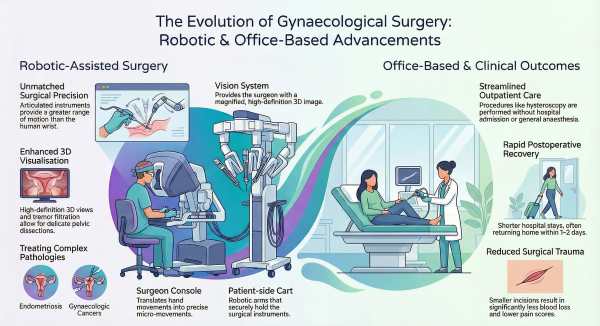
Robotic-assisted surgery represents a significant leap forward, providing enhanced dexterity, three-dimensional visualization, and tremor filtration, enabling surgeons to perform delicate procedures with exceptional precision. This is particularly beneficial in complex oncological surgeries and deep pelvic dissections.
At the same time, office-based gynecologic procedures have transformed outpatient care by shifting many diagnostic and therapeutic interventions—such as hysteroscopy and endometrial ablation—into day-care settings. These approaches reduce the need for hospitalization, lower costs, and improve patient convenience.
Overall, these advancements lead to reduced blood loss, shorter hospital stays, faster recovery, less postoperative pain, and improved cosmetic outcomes. As technology continues to evolve, minimally invasive and robotic techniques are becoming the standard of care in gynecology, enhancing both clinical outcomes and patient satisfaction.
🔹 Surgery in Gynecology
🔧
Robotic-assisted surgery is one of the most transformative innovations in the field of minimally invasive surgery. It involves the use of sophisticated robotic platforms, most commonly the da Vinci Surgical System, which translates the surgeon’s hand movements into precise micro-movements of surgical instruments inside the patient’s body.
Technology and Working Mechanism
The robotic system consists of three main components:
- Surgeon Console – where the surgeon sits and controls the instruments
- Patient-side Cart – robotic arms that hold surgical instruments
- Vision System – provides a high-definition 3D view
The surgeon operates in a seated position, viewing a magnified, three-dimensional image of the operative field. The robotic arms replicate the surgeon’s movements with enhanced precision, eliminating tremors and allowing fine dissection even in confined anatomical spaces.
Applications in Gynecology
Robotic-assisted surgery is widely used in managing:
- Uterine fibroids (myomectomy, hysterectomy)
- Endometriosis, especially deep infiltrating disease
- Gynecologic cancers, including cervical, ovarian, and endometrial cancers
- Pelvic organ prolapse repair
- Infertility-related surgeries
In complex cases like deep infiltrating endometriosis or radical hysterectomy, robotic systems offer better visualization and access to difficult pelvic areas.
Advantages
Robotic surgery offers several clinically significant benefits:
- Higher precision due to articulated instruments with greater range of motion than the human wrist
- Reduced blood loss, especially in vascular pelvic surgeries
- Minimal postoperative pain due to smaller incisions
- Shorter hospital stay, often 1–2 days
- Faster recovery, allowing early return to daily activities
- Lower complication rates in experienced hands
- Better ergonomics for surgeons, reducing fatigue during long procedures
Limitations
Despite its advantages, robotic surgery has certain challenges:
- High cost of equipment and maintenance
- Longer setup time compared to conventional laparoscopy
- Steep learning curve for surgeons
- Limited availability in smaller healthcare centers
However, as technology becomes more accessible, these barriers are gradually reducing.
🏥 Office-Based Gynecologic Procedures
Office-based procedures represent another major advancement in gynecology, focusing on patient convenience and cost-effectiveness. These procedures are performed in outpatient settings without the need for hospital admission or general anesthesia in most cases.
Common Procedures
- Hysteroscopy
A minimally invasive procedure where a thin telescope-like instrument is inserted through the cervix to visualize the uterine cavity. It is used for diagnosing and treating:- Abnormal uterine bleeding
- Polyps
- Submucous fibroids
- Adhesions (Asherman’s syndrome)
- Endometrial Ablation
A procedure to destroy the uterine lining to treat heavy menstrual bleeding. Techniques include thermal, radiofrequency, or cryoablation methods. - Endometrial Biopsy
A simple outpatient procedure to sample the uterine lining for diagnostic purposes. - Polypectomy and Minor Operative Procedures
Removal of small intrauterine lesions without the need for operating theatre admission.
Advantages of Office-Based Procedures
These procedures have significantly changed patient care dynamics:
- Reduced hospital stay – performed as day-care or same-day discharge
- Lower costs – no need for operation theatre or inpatient admission
- Minimal anesthesia requirements – often done under local anesthesia or no anesthesia
- Faster recovery – patients can resume routine activities quickly
- Increased patient comfort and convenience
- Reduced risk of hospital-acquired infections
Patient Selection
Not all patients are suitable for office procedures. Proper selection is essential:
- Hemodynamically stable patients
- Small or moderate pathology size
- No severe comorbid conditions
- Cooperative and informed patients
Complex cases may still require operating room settings.
🔄 Integration of Minimally Invasive Approaches
Both robotic-assisted surgery and office-based procedures are part of a broader shift toward minimally invasive gynecology. This approach prioritizes:
- Preservation of normal anatomy
- Reduced surgical trauma
- Enhanced recovery protocols
- Improved patient satisfaction
Enhanced Recovery After Surgery (ERAS) protocols further complement these techniques by optimizing perioperative care, including early mobilization, minimal opioid use, and early feeding.
📊 Clinical Impact and Outcomes
Numerous studies have demonstrated that minimally invasive and robotic techniques result in:
- Lower intraoperative blood loss
- Reduced postoperative pain scores
- Decreased infection rates
- Shorter hospital stays
- Quicker return to work and daily life
In gynecologic oncology, robotic surgery has shown comparable oncologic outcomes to open surgery, with added benefits of reduced morbidity.
🔮 Future Directions
The future of minimally invasive and robotic gynecology is promising, with ongoing advancements such as:
- Artificial intelligence integration for surgical guidance
- Augmented reality overlays for better anatomical visualization
- Miniaturized robotic systems
- Remote telesurgery, allowing expert surgeons to operate from distant locations
Training programs are also evolving to include simulation-based learning, improving surgeon proficiency and patient safety.
Conclusion
Minimally invasive and robotic surgery have fundamentally transformed gynecological care by making procedures safer, more efficient, and patient-centered. Robotic-assisted surgery offers unmatched precision for complex conditions like fibroids, endometriosis, and gynecologic cancers, while office-based procedures enhance accessibility and affordability of care.
Together, these innovations reduce the physical and emotional burden of surgery, improve outcomes, and represent the future of modern gynecology. As accessibility increases and technology advances, these techniques are expected to become the gold standard across diverse healthcare settings.